Breach disclosure takes a median 6 days by Form 8-K and months by state notice
The log's pooled median of 76 days describes neither route: Form 8-K filings follow discovery in days, state breach notices in months.
Compiled from public records. Updated . By the cisonews.net Desk.
In this log a Form 8-K follows the stated discovery of an incident by a median of 6 days and a state attorney general notice by a median of 108.5 days, so the route a disclosure takes decides how long the wait is.
How long do companies take to disclose a data breach, route by route?
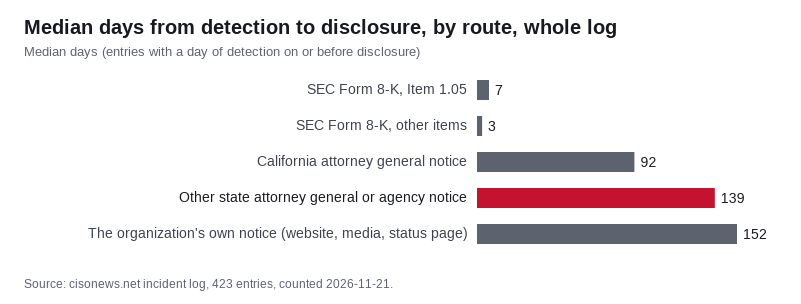
SEC Form 8-K filings in the log follow the stated discovery by a median of 6 days. State notices, meaning those filed with California's attorney general and with other states' attorneys general or consumer agencies, follow it by a median of 108.5 days. Pooled across every route, the median is 76 days.
The comparison that shows how far apart the routes sit is at the slow edge of the fast route: the longest Form 8-K gap in the log is 91 days, shorter than the median state notice. A wait that is the longest on the Form 8-K route would sit below the middle of the state notices.
The short and long ends of the log belong to different routes. Form 8-K filings make up 96% of the log's gaps of 7 days or fewer, and state notices 94% of its gaps of more than 180 days. The fast end of the log is almost all Form 8-K filings, and the slow end is almost all state notices.
The pooled median describes neither route, and the reason is the make-up of the pool. State notices supply 75% of the counted gaps and Form 8-K filings 21%. The pooled figure reports the mix of documents the log has collected as much as the pace of any disclosure in it. A question about how long disclosure takes has no useful answer from these figures until the route is named.
The organizations' own notices, published on a website, to the media or on a status page, have a median of 152 days. That figure rests on 13 counted gaps out of 17 entries, and the log published its first entry of this kind on 10 November 2026. A base that small supports no ranking against the state lists; it shows that the own notices counted so far ran to months, and little beyond that.
| Route | Entries | Gaps counted | Median days | Longest gap (days) |
|---|---|---|---|---|
| State notices (California and other states together) | 313 | 254 | 108.5 | 746 |
| California attorney general notices | 166 | 131 | 92 | 746 |
| Other state attorney general or agency notices | 147 | 123 | 139 | 503 |
| SEC Form 8-K filings (all items) | 91 | 72 | 6 | 91 |
| Form 8-K, Item 1.05 | 48 | 42 | 7 | 91 |
| Form 8-K, other items | 43 | 30 | 3 | 16 |
| Organizations' own notices | 17 | 13 | 152 | 324 |
| Whole log | 423 | 339 | 76 | 746 |
Why did I get a data breach letter months later?
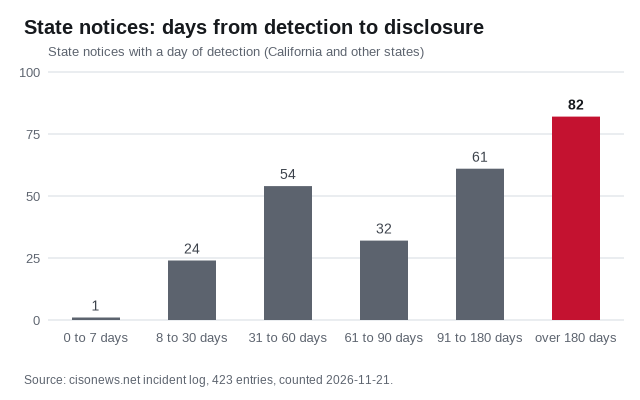
On the state route, a wait of months is what the log mostly records. Of the 254 state notices with a countable gap, 56% are dated more than 90 days after the discovery they state, and 32% more than 180 days after it. Only 25 came within 30 days. The state notices with gaps of more than 180 days, 82 of them, outnumber every countable Form 8-K gap in the log, 72 in all. On this route a notice dated months after the stated discovery is the ordinary case, and a quick one is uncommon. The figures say how common the wait is among these notices and nothing about whether any of it was justified.
For a letter that came through another state's list rather than California's, the wait in the log is longer still. Other states' lists, taken together, have a median of 139 days, against 92 days for California. Of their counted gaps, 63% run past 90 days, against 50% of California's. On those lists a letter months after the stated discovery is more common still than on California's. The other-state figure pools different states' lists and agencies, so it is the figure of that pool and belongs to no particular state.
The discovery date in a notice can mark the end of an investigation as well as its start, and the notice from the American Board of Preventive Medicine, dated October 13, 2026, shows the later kind. ABPM says it found out that someone without authorization had been inside its network. It gives its discovery as about September 24, 2026, reached "After an extensive forensic investigation and complex manual document review", and it places the access to the files the notice concerns at about March 8 to 10, 2026. Counted as the log counts it, the wait runs from September 24 to October 13, 2026. Counted from the access the notice describes, it runs from March to October.
The notice from Fandango Media, LLC is dated November 13, 2026. It says an investigation found signs that an outside party could reach payment card details tied to some checkout transactions between October 8 and October 11, 2026. The notice describes the company as having learned of the checkout problem recently, looked into it with outside specialists and fixed it. The entry's record gives October 30, 2026 as the day the incident was found and November 13, 2026 as the date of the notice. That places the notice among the California gaps that ended within 30 days, which are 11% of that list's counted gaps. Access, discovery and notice all fall within weeks of each other here.
At the long end are notices whose stated discovery lies more than a year back. The notice from Magna Hospitality Group, dated October 13, 2026, says the company learned on May 24, 2025 of suspicious activity on some of its systems and started investigating without delay. The Inner City Education Foundation, in a notice dated October 16, 2026, says it learned of suspicious network activity on September 30, 2024. On California's list, 38 of the 131 counted gaps run to more than 180 days. Among the log's state notices, the longest gap is 746 days.
Read together, the notices place the stated discovery at different distances from the events they describe, and each counted gap runs from the discovery date the notice states to the date of the notice. For someone holding a letter, the gap is a lower bound on the time since the access: where the access came before the stated discovery, as in ABPM's notice, the time since the access is longer than the gap the log counts.
How many days after a breach is an 8-K Item 1.05 filed?
On the Form 8-K route the wait is counted in days. Item 1.05 filings in the log have a median gap of 7 days across 42 counted gaps. Form 8-K filings that reported an incident under other items, such as Item 8.01, have a median of 3 days across 30; an 8-K originally filed under another item and later amended into Item 1.05 is counted under its original item. Taking every Form 8-K together, 64% of the gaps ended within 7 days and 93% within 30 days. On this route a filing within 30 days of the stated discovery is the ordinary case, and a longer wait is rare.
The state route has one gap within 7 days of the stated discovery. For a reader who sees a filing or a notice within a week of the stated discovery, the route decides how unusual that is: on the state route it is almost without precedent in this log, and on the Form 8-K route it is the usual case.
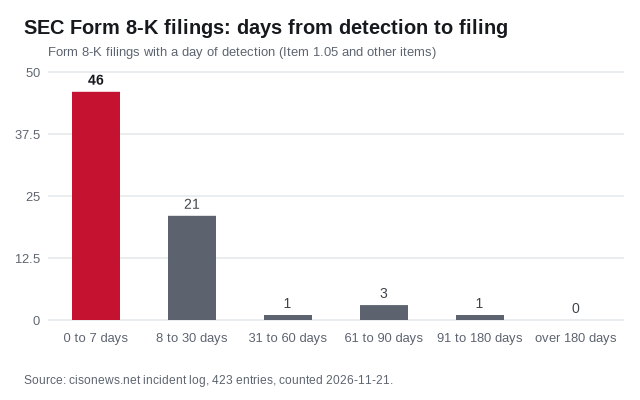
The long Form 8-K gaps are Item 1.05 filings, where the longest is 91 days. The choice of route moves the median by months: the state-notice median is 108.5 days. The comparison that fits an Item 1.05 filing is the Item 1.05 median, since the all-items figure blends both kinds of filing.
The rule behind these filings sets a short clock, and that clock starts somewhere other than discovery. The SEC's statement on the rule puts it in a sentence: "An Item 1.05 Form 8-K will generally be due four business days after a registrant determines that a cybersecurity incident is material." Each gap in the log runs from the day the organization found the incident, as the entry gives it, to the date of the filing, while the SEC's four business days run from the determination that the incident is material. The Item 1.05 median of 7 days starts from a different day than the rule's clock, so it neither meets nor misses that deadline.
The entries show the range by their dates. River Financial filed under Item 1.05 on June 25, 2026; the filing says River spotted the activity on or about June 19, 2026 and found that ransomware had been set loose across part of its servers. F5 filed under Item 1.05 on October 15, 2025; the filing says the company learned on August 9, 2025 that a nation-state threat actor had got into some of its systems without authorization. River's dates are days apart. F5's run from August 9 to October 15, 2025, which puts it among the few Item 1.05 filings past 30 days: five of the 42 counted gaps. The same filing records a delay the rule allows: "On September 12, 2025, the U.S. Department of Justice determined that a delay in public disclosure was warranted pursuant to Item 1.05(c) of Form 8-K."
A filing this quick can arrive before the company's own account is complete. Bitcoin Depot filed on April 8, 2026, and the filing dates the company's discovery of the intrusion to March 23, 2026. The filing says the company had found no evidence that customers' personal information was reached or taken, and adds that "the investigation remains ongoing". This filing was made while the company's findings were, by its own words, still open.
The SEC's statement on the rule says that a cybersecurity incident, like a factory lost in a fire, may be material to investors. In the log, a Form 8-K entry's disclosure date is the date of the filing, so each gap on this route ends at a filing with the SEC and records no date on which the people affected were told.
How should a company benchmark its own breach disclosure timeline?
A company that measures its own timeline against the pooled median is measuring it mostly against state notices. On the Form 8-K route, five counted gaps run past 30 days; on the state route, 56% of the counted gaps run past 90 days. A gap equal to the pooled median of 76 days is longer than most Form 8-K gaps in the log and shorter than most state-notice gaps.
The state lists differ from each other by weeks, the routes by months: California's median is 92 days and the other states' 139, against 6 for Form 8-K filings. Which state list a notice appears on moves the benchmark much less than which route the disclosure took.
| State list | Gaps counted | Median days | Within 30 days | More than 90 days | More than 180 days |
|---|---|---|---|---|---|
| California attorney general notices | 131 | 92 | 15 | 66 | 38 |
| Other state attorney general or agency notices | 123 | 139 | 10 | 77 | 44 |
For a California notice, the list's own figures give the position. On California's list, 11% of the counted gaps ended within 30 days while 50% ran past 90 days. A notice just past 90 days sits near the middle, since 66 of the California gaps ran past 90 days and 65 did not.
For a board asking whether a disclosure was slow, the figures support an answer about position within a route. Among state notices, 44% of the counted gaps ended within 90 days. Among Form 8-K filings, 71 of the 72 counted gaps did. A Form 8-K filed more than 30 days after the stated discovery would sit past the 93% of Form 8-K gaps that ended within 30 days, while a state notice dated within 30 days of its stated discovery would sit among the quickest 10% of its route. Past 180 days the comparison has only one side: 32% of state gaps run that long, and the longest Form 8-K gap, 91 days, falls short of it. The same number of days reads as early on a state list and as late in an SEC filing.
The SEC's four business days apply to an Item 1.05 Form 8-K and run from the determination that the incident is material. Set against that clock, almost every state notice in the log would look late, since only 25 of the 254 counted state gaps ended within 30 days of the stated discovery. That comparison mixes clocks that start on different days and govern different documents, and the log's figures do not support it.
How long does a company have to notify you of a data breach?
Maryland sets a limit in days. Its Commercial Law Article § 14-3504 says notification to residents "shall be given as soon as reasonably practicable, but not later than 45 days after the business discovers or is notified of the breach of the security of a system". The same statute has the business tell the Attorney General's office before it tells residents.
California's filing rule works differently. In the passage the log reads, Civil Code § 1798.82 requires a business that must notify more than 500 California residents of a single breach to send the Attorney General a sample copy of the notice electronically, and that passage sets no number of days.
The rules a reader meets in these documents start their clocks in different places. The SEC's four business days start at the determination that an incident is material. Maryland's 45 days start when the business discovers the breach or is notified of it, and they end at the notice to residents. Neither rule's interval is the one the log counts: each gap ends at the date of the filing or notice the log read, not at the day a letter reached any person, and starts from the discovery date the document states, which the log cannot match to the moment a statute or rule counts from. The gaps record how long organizations took by the dates in their own documents, and they test no notice against a deadline.
Is the wait for breach notification getting shorter?
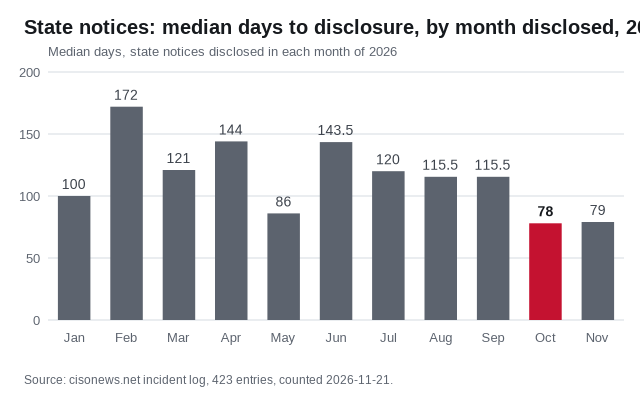
The monthly medians for state notices cannot yet say whether the wait is getting shorter. State notices disclosed in October 2026 have a median gap of 78 days on 46 counted gaps, against 172 days on 13 for February 2026, but the log began on 27 September 2026 and added earlier months after the fact. November 2026, at 79 days on 28 counted gaps, was not over on the day of the count. The lower figures in the latest months may reflect how the months were gathered rather than a change in practice, and no trend can be read from them yet.
What can the log not show?
On 21 November 2026 the log held 423 entries and counted a gap in 339 of them, those whose document states the day of discovery on or before the day of the disclosure. Of the others, 72 give no discovery date, 11 give a month without a day, and one gives a date after its own disclosure. Every discovery date is the organization's statement in its own document, taken as written, and incidents that were never disclosed are absent. Nothing in the figures says what filled the days between discovery and disclosure, or why one gap is longer than another.
Method and data
The figures were counted by the site's own script on 2026-11-21 from content/incidents, the entries of the cisonews.net log. On that day the count found 423 entries in the whole log. An entry's disclosure date is the date of the filing or notice that disclosed the incident. The gap from detection to disclosure is counted only where the filing or notice states the day the organization found the incident, on or before the disclosure date (a detection date the entry marks as a month gives only a month): 351 of the log's entries carry a detection date, 11 of the log's entries give only a month and 1 of the log's entries give a date after the disclosure, which leaves 339 gaps across the whole log with a dated detection. A median is the middle gap of a group (the mean of the middle pair when the group has an even count). Routes follow the document the entry was written from: an SEC Form 8-K, under Item 1.05 when its first filing was made under that item; a California attorney general notice; a notice filed with another state's attorney general or consumer agency; or the organization's own notice or a settlement. Entries of each route dated before the day the log published its first entry of that route were added on or after that day. Download the log's entries as CSV (423 rows, one per entry of the log: company, form, route, sector, disclosure date, detection date, days between them and the filing).
Sources
- 2026-10-13 · AAmerican Board of Preventive Medicine, notice filed with the California Attorney General, published October 13, 2026
- 2026-11-13 · AFandango Media, LLC, notice filed with the California Attorney General, published November 13, 2026
- 2026-10-13 · AMagna Hospitality Group, notice filed with the California Attorney General, published October 13, 2026
- 2026-10-16 · AInner City Education Foundation, notice filed with the California Attorney General, published October 16, 2026
- 2026-11-04 · AU.S. Securities and Exchange Commission, press release 2023-139, published November 4, 2026
- 2026-06-25 · ARiver Financial Corporation, Form 8-K (SEC EDGAR), published June 25, 2026
- 2025-10-15 · AF5, Inc., Form 8-K (SEC EDGAR), published October 15, 2025
- 2026-04-08 · ABitcoin Depot Inc., Form 8-K (SEC EDGAR), published April 8, 2026
- 2026-11-04 · AMaryland General Assembly, Commercial Law Article § 14-3504, published November 4, 2026
- 2026-11-04 · ACalifornia Department of Justice, Office of the Attorney General, Data Security Breach Reporting, published November 4, 2026
Tier A: the organization itself (including notices it filed with a state attorney general), a regulator or SEC EDGAR. Tier B: established press. Each fact on this page carries its supporting passage in the page source.
Entries like this one, in Wednesday’s docket
Wednesdays
Unsubscribe any time.